

You leave for work feeling sharp in a new pair of shoes, but by your second coffee break, a dull ache in your arches is all you can think about. By the time the afternoon ends, every step feels like a chore. It's a frustrating cycle that many men face when trying to find comfortable men's shoes that actually deliver on their promises. You deserve footwear that supports your routine rather than distracting you from it.
We know that a shoe needs to do more than just look good for an hour. Truly reliable footwear balances cushioning with structural stability to protect your feet during long hours of movement. This guide will help you identify the essential technical features that prevent common pains like heel strain and arch fatigue. You'll learn how to select versatile styles that transition seamlessly from the workplace to your weekend plans. We're here to simplify your search and give you the tools to make confident decisions when shopping online.
Key Takeaways
- Learn why excessive cushioning can lead to fatigue and how to identify the balance between softness and structural stability.
- Understand the three key layers of shoe anatomy to ensure your footwear provides genuine arch and heel support.
- Discover how to select comfortable men's shoes that transition seamlessly between professional environments and casual weekend routines.
- Apply the "End of Day" rule and at-home measurement steps to guarantee a precise fit when purchasing online.
- Explore how direct-to-consumer models provide high-quality daily footwear focused on utility rather than luxury markups.
What Makes a Men's Shoe Actually Comfortable?
True comfort is more than a soft initial feel. It is a precise balance between support, flexibility, and breathability. Many men mistake a "squishy" sole for quality, but real comfort is defined by how your feet feel after standing for six hours. From the history of shoes as basic protective wraps to modern ergonomic designs, the goal has evolved toward supporting the body's natural movement. Finding comfortable men's shoes requires looking past the showroom floor and evaluating how a shoe manages three specific touchpoints: the heel, the arch, and the toe box.
The heel must be locked in place to prevent slipping and blisters. The arch needs to be met with contoured material to distribute weight evenly. Finally, the toe box must be wide enough to allow your toes to splay naturally as you walk. If any of these areas are neglected, even the softest foam won't prevent pain by the end of the day. Weight also plays a significant role in your daily energy levels. Heavy shoes act like anchors during a commute. Every extra ounce requires your leg muscles to work harder, which leads to premature fatigue.
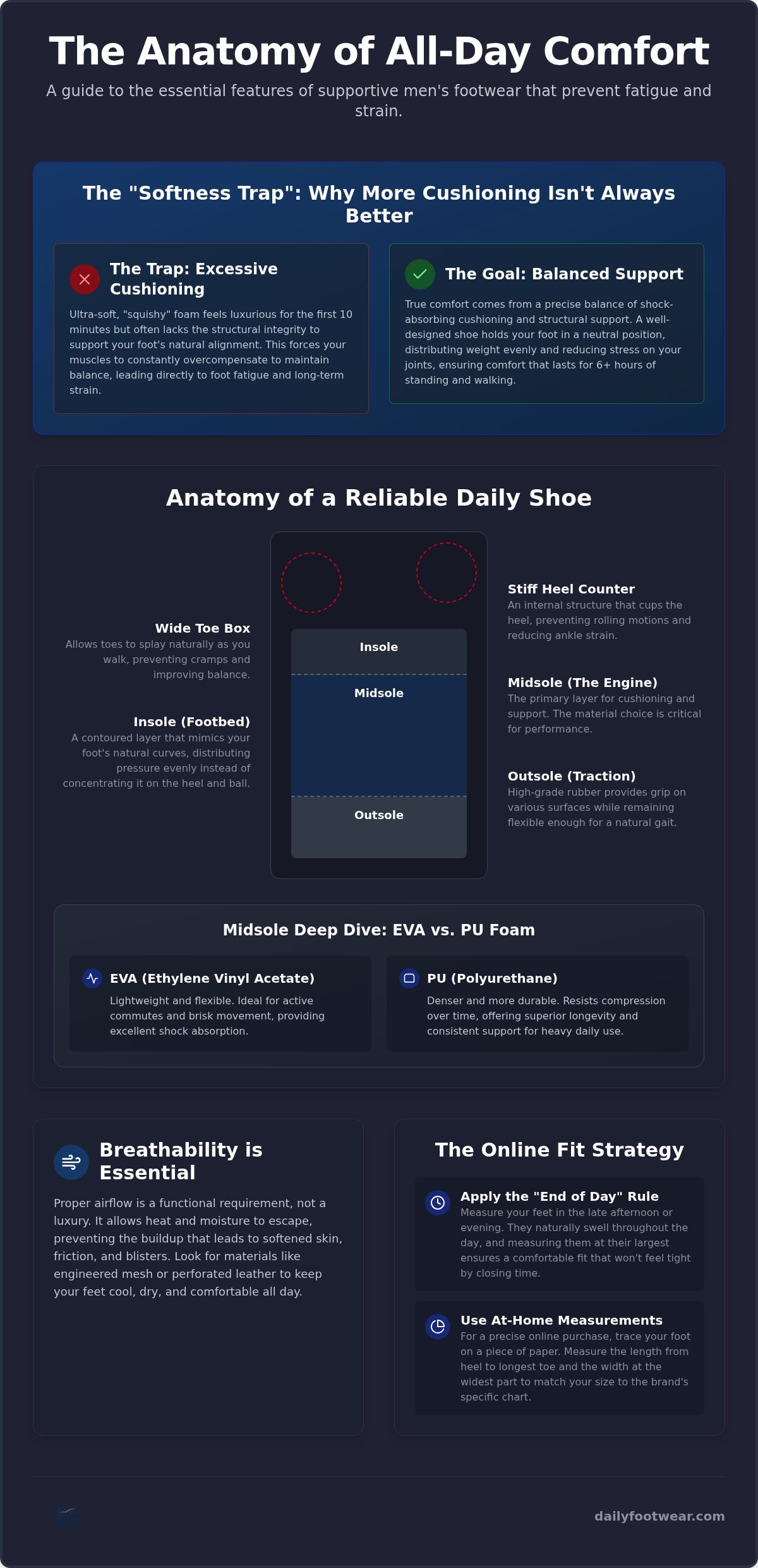
Avoid the "Softness Trap" when shopping. While ultra-soft cushioning feels like walking on a cloud for the first ten minutes, it often lacks the density required to hold your foot in a neutral position. Without a stable foundation, your foot muscles must work constantly to balance themselves. This overcompensation is a primary cause of foot fatigue and long-term strain.
Support vs. Cushioning: Knowing the Difference
Cushioning and support serve two distinct purposes. Cushioning is designed to absorb the shock of your feet hitting the pavement. This is vital for high-impact activities like running or brisk walking. Support is different; it is about alignment. If you spend most of your day standing still or moving at a slow pace, support is your priority. Arch support acts as a structural necessity for long-term comfort by maintaining the foot's natural alignment and preventing the collapse of the midfoot under pressure. A shoe with great support keeps your skeleton stacked correctly, reducing stress on your knees and lower back.
The Importance of Breathability for Daily Wear
Breathability is a functional requirement, not a feature. When heat and moisture build up inside a shoe, the skin softens and becomes prone to friction and blisters. This moisture also creates an environment for bacteria to grow. Look for comfortable men's shoes made with materials like engineered mesh, perforated leather, or moisture-wicking linings. These materials allow air to circulate and help regulate the temperature of your feet. When your feet stay dry and cool, you perceive the shoe as being more comfortable over the course of a full workday.
The Anatomy of a Reliable Daily Shoe
Understanding how a shoe is built helps you spot quality before you even put it on. A reliable daily shoe is composed of three essential layers: the insole, the midsole, and the outsole. Each layer has a specific job in creating comfortable men's shoes that last through a full shift. When these components work together, they reduce the physical toll on your body.
The insole is the layer directly under your foot. While many basic shoes use flat, generic foam, a high-quality insole uses a contoured footbed. These designs mimic the natural curves of your foot. This ensures your weight is distributed across the entire surface rather than concentrating pressure on the heel and the ball of the foot. Many reliable designs also feature removable insoles, allowing you to swap them out as they wear down over time.
Located between the insole and the outsole, the midsole is the engine of the shoe. Most industry leaders use Ethylene Vinyl Acetate (EVA) or Polyurethane (PU) foams for this layer. EVA is prized for being lightweight and flexible, making it ideal for brisk movement and active commutes. PU is denser and slightly heavier, but it offers superior longevity. It resists compression better than EVA, meaning the support won't "bottom out" after a few months of heavy use. You can explore our collection of men's shoes to see how these materials are used to provide lasting support.
The outsole is the bottom layer that meets the ground. In urban environments, you need a balance of traction and flexibility. A high-grade rubber outsole should grip wet or smooth surfaces to prevent slips. It must also be flexible enough to bend at the ball of the foot, matching your natural gait without resistance.
Heel Cups and Stability Features
Stability starts at the back of the shoe. A deep heel cup centers your foot and prevents the rolling motion that leads to ankle strain and fatigue. To further protect your joints, look for a moderate heel-to-toe drop. This height difference between the heel and the forefoot reduces the tension on your Achilles tendon during long walks. A stiff heel counter is also essential. This is the internal structure reinforcing the back of the shoe. It holds your foot securely, ensuring the shoe moves with you rather than shifting independently.
The Toe Box: Why Room to Wiggle Matters
Your toes need space to splay. When you step down, your foot naturally widens to balance your weight. Narrow shoes pinch the toes together, which can cause long-term issues like bunions or nerve pain. It's important to distinguish between a "wide fit" shoe, which is larger throughout the entire frame, and a shoe with a "natural toe box." A natural toe box specifically widens at the front to accommodate the toes. To check for a proper fit, ensure there's about a half-inch of space between your longest toe and the front of the shoe. You should be able to wiggle your toes freely without feeling the sides of the material.
Choosing the Right Style for Your Routine
Your daily schedule should dictate the technical features you prioritize. A professional who spends eight hours at a desk has different requirements than a commuter walking two miles to the train station. Finding comfortable men's shoes is about matching the internal tech of the shoe to your specific environment. When your footwear aligns with your activity, you reduce the risk of localized pain and general fatigue.
The professional hybrid is a modern solution for the traditional workplace. These designs combine the clean, polished aesthetic of a dress shoe with the internal engineering of a sneaker. They often hide EVA midsoles and contoured footbeds beneath high-quality leather uppers. This allows you to maintain a professional appearance without the stiff, unforgiving feel of old-fashioned footwear. It is an essential style for men who need to move between meetings and city streets without switching shoes.
For those who walk to work, weight is the primary concern. The commuter essential focuses on lightweight synthetic materials and high-tech knits that reduce the energy required for every step. These shoes prioritize flexibility at the forefoot, ensuring your foot moves naturally on hard concrete. Similarly, weekend casual styles shouldn't sacrifice support for ease. Slip-on shoes are convenient, but they must still feature a dedicated arch structure and a deep heel cup to prevent your feet from tiring during errands or social events.
Comfortable Shoes for the Office
In a professional setting, look for understated designs that conceal their comfort technology. Leather and high-quality synthetics are the preferred materials here because they offer better structural integrity than canvas. This structure helps the shoe maintain its shape and support throughout a long shift. For more advice on balancing aesthetics with utility, see our guide on Casual Shoes for Men: A Guide to Daily Versatility.
Walking Shoes for Commuting and Travel
Concrete and asphalt are unforgiving surfaces that transmit impact directly to your joints. Prioritize shoes with high shock absorption in the midsole to dampen this vibration. Slip-resistant outsoles are also a critical safety feature, providing necessary traction on slick subway tiles or wet sidewalks. You can find detailed technical breakdowns in our resource on the Best Walking Shoes for Men: Commuter Essentials. Focusing on these specific utility features ensures your feet remain supported regardless of the weather or terrain.
The Online Fit Strategy: Ensuring Comfort Before You Buy
Buying comfortable men's shoes online is simple if you follow a repeatable process. Most people order their usual size and hope for the best. This often leads to returns because sizing varies significantly between different manufacturers and shoe lasts. To get a perfect fit the first time, you must account for the physical changes your feet undergo throughout a typical workday. A methodical approach removes the guesswork from the shopping experience.
The "End of Day" rule is the most important factor in sizing. Always measure your feet in the evening. Gravity and hours of movement cause your feet to swell as the day progresses. A shoe that feels perfect at 8:00 AM will likely feel restrictive and painful by the middle of the afternoon. Measuring at your foot's largest state ensures all-day comfort without the risk of pinching. You also need to account for your choice of socks. A thick athletic sock takes up more volume than a thin dress sock. Perform your measurements while wearing the style you intend to use with the new footwear.
Understanding width is just as critical as length. If you often feel pressure on the sides of your pinky toe or the ball of your foot, you likely need a wide fit. A standard width should secure your foot without squeezing the metatarsals. If the material of your current shoes bulges over the edges of the sole, it's a clear sign you should size up in width. You can view our sizing guide to learn how to choose shoe size online like a pro.
How to Measure Your Foot at Home
Follow these three steps for an accurate measurement. First, place a piece of paper on a flat, hard surface. Stand on it with your full weight and trace the outline of your foot. Standing is vital because your foot spreads under your body weight. Second, measure the length from the heel to your longest toe and the width at the widest part of your forefoot. Use millimeters for the most precise result. Third, compare these specific numbers to the brand size chart. This is the most reliable way to ensure your comfortable men's shoes actually fit your unique foot shape.
The "Finger Test" for Proper Fit
When your shoes arrive, try them on and stand up. Press your thumb down at the front of the shoe. You should have about a half-inch of space between your longest toe and the tip. This allows for "toe splay" and prevents your toes from hitting the front during a brisk walk. Next, walk around to check the heel. It should stay seated without slipping. If your heel lifts out of the shoe, the size is likely too large or the heel counter isn't deep enough to secure your foot.
Practical Daily Comfort at Daily Foot Wear
Daily Foot Wear serves as your partner in navigating the demands of a busy schedule. We prioritize functional excellence over fleeting fashion trends. Our selection focuses on the technical features discussed in this guide, such as heel stability and midsole density. By specializing in daily wear, we ensure that every pair in our catalog is built for movement and endurance. We curate our catalog with a focus on real-world application. Instead of offering thousands of overwhelming options, we select footwear that meets our standards for durability and support. Each pair is evaluated for its ability to handle the repetitive stress of a commute or a full day on your feet. This methodical approach ensures that our comfortable men's shoes deliver consistent performance from the first wear.
We operate as a direct-to-consumer retailer. This model removes the traditional markups associated with luxury branding and third-party wholesalers. You receive high-quality materials and thoughtful engineering at a fair price. Our goal is to provide comfortable men's shoes that offer genuine value without unnecessary complexity. Our direct-to-consumer approach allows us to maintain a transparent relationship with our customers. By cutting out the middleman, we focus our resources on better materials and more precise construction. This is a pragmatic choice that prioritizes the product's utility over marketing hype. We believe that quality should be accessible to everyone who needs a reliable partner for their daily routine.
Readiness is at the core of our philosophy. Whether you're commuting, standing for a long shift, or running errands, your footwear should work with you. We use grounded, descriptive language to help you understand exactly what you're buying. We believe in movement-focused footwear that removes friction from your life. This means providing shoes that are easy to wear, easy to maintain, and easy to trust. Our process is designed to save you time and provide peace of mind.
Why Our Men's Collection Stands Out
Our collection is designed for versatility. We focus on styles that transition easily from a professional office setting to a casual dinner. We avoid dense industry jargon and provide transparent descriptions of every shoe's construction. This clarity helps you categorize your needs and select the right tool for the job. Daily Foot Wear is the dependable choice for those who value reliable support and straightforward utility in their everyday footwear.
Shop with Confidence
Our online platform is built to be user-centric and efficient. We've removed the friction from the digital shopping process so you can find what you'll need quickly. The layout is logical and linear, moving you seamlessly from broad categories to specific product details. If you have questions about sizing or specific features, our support team is available to provide direct assistance. We want you to feel secure in your purchase and ready for the day ahead.
Explore our full range of comfortable men's shoes to find your next pair.
Step into Lasting Daily Support
Finding the right footwear is a practical investment in your daily productivity. You now understand that comfortable men's shoes require more than just a soft feel; they need a precise balance of arch support, heel stability, and a spacious toe box. By measuring your feet in the evening and matching shoe features to your specific routine, you eliminate the guesswork that often leads to afternoon fatigue.
Daily Foot Wear acts as your essential partner in this search. Our collection is curated specifically for daily utility and movement. We've simplified the shopping process with a user-centric online experience that prioritizes your time and convenience. You can trust that our offerings focus on reliable everyday readiness and functional excellence without unnecessary complexity or luxury markups.
Shop Comfortable Men's Footwear at Daily Foot Wear to find your next reliable pair. Your feet will appreciate the difference that thoughtful engineering makes in every step you take.
Frequently Asked Questions
What are the most comfortable shoes for standing on concrete all day?
The most comfortable shoes for standing on concrete feature thick, high-density midsoles made of EVA or PU foam. Concrete is an unforgiving surface that doesn't absorb impact, so your footwear must do that work. Look for designs with a rubber outsole for grip and a contoured footbed to distribute your weight. These features prevent the localized pressure that leads to heel pain and lower back strain during long shifts.
How do I know if I need wide-fit shoes?
You likely need wide-fit shoes if you experience pinching at the pinky toe or the ball of your foot. Check if the material of your current shoes bulges over the edge of the sole. Another sign is constant pressure on the sides of your feet, even if the length is correct. Measuring the widest part of your foot in millimeters and comparing it to a brand's specific width chart is the most accurate way to confirm.
Can casual shoes provide enough arch support for flat feet?
Yes, many casual styles are designed with built-in contoured footbeds specifically for flat feet. High-quality comfortable men's shoes prioritize internal structure over just external aesthetics. If a casual shoe lacks sufficient support, ensure it has a removable insole. This allows you to insert a custom orthotic or a more supportive aftermarket footbed without making the shoe feel too tight or restrictive.
How often should I replace my daily work shoes for maximum comfort?
Most daily work shoes should be replaced every six to twelve months depending on your activity level. While the outside might look fine, the internal foam in the midsole eventually compresses and loses its ability to absorb shock. If you walk several miles a day, you might reach this point after 300 to 500 miles. Once you notice new aches in your feet or knees, it's usually time for a new pair.
Are slip-on shoes as supportive as lace-up shoes?
Lace-up shoes generally provide more support because they allow you to customize the tightness across your midfoot. This keeps your foot from sliding forward or sideways. However, high-quality slip-ons can be supportive if they feature a deep heel cup and a reinforced heel counter. These structures lock the foot in place. For high-activity days involving lots of walking, a lace-up design is often the more reliable choice for maintaining stability.
What is the best material for breathable men's shoes?
Engineered mesh is the best material for maximum airflow and temperature regulation. It allows heat to escape while keeping the shoe lightweight. If you require a more professional look, perforated leather is a functional alternative that provides durability with added ventilation. Look for shoes with moisture-wicking linings as well. These linings pull sweat away from the skin, which helps prevent the friction and blisters caused by damp environments.
Why do my feet hurt even when I wear expensive shoes?
Expensive shoes often focus on luxury materials or brand prestige rather than ergonomic support. If your shoes are too soft, they lack the stability needed to keep your foot aligned, leading to muscle fatigue. Price doesn't guarantee a proper fit for your specific foot shape or arch type. You might be wearing the wrong size or a style that doesn't match your daily routine, proving that technical features matter more than the price tag.
Is there a difference between walking shoes and running shoes for daily use?
Running shoes are engineered for high-impact forward motion and often have extra cushioning in the heel. Walking shoes prioritize flexibility at the ball of the foot and provide more consistent support across the entire sole. For daily use, walking shoes are often more stable. They are designed for the slower, more deliberate gait used during a commute or while standing in professional settings. This makes them a more practical choice for everyday readiness.